
The chain has moved beyond a launch narrative
Robinhood Chain is usually introduced as infrastructure for tokenized real-world assets. That description is directionally correct, but it is not enough to explain the market that has started to form around it.
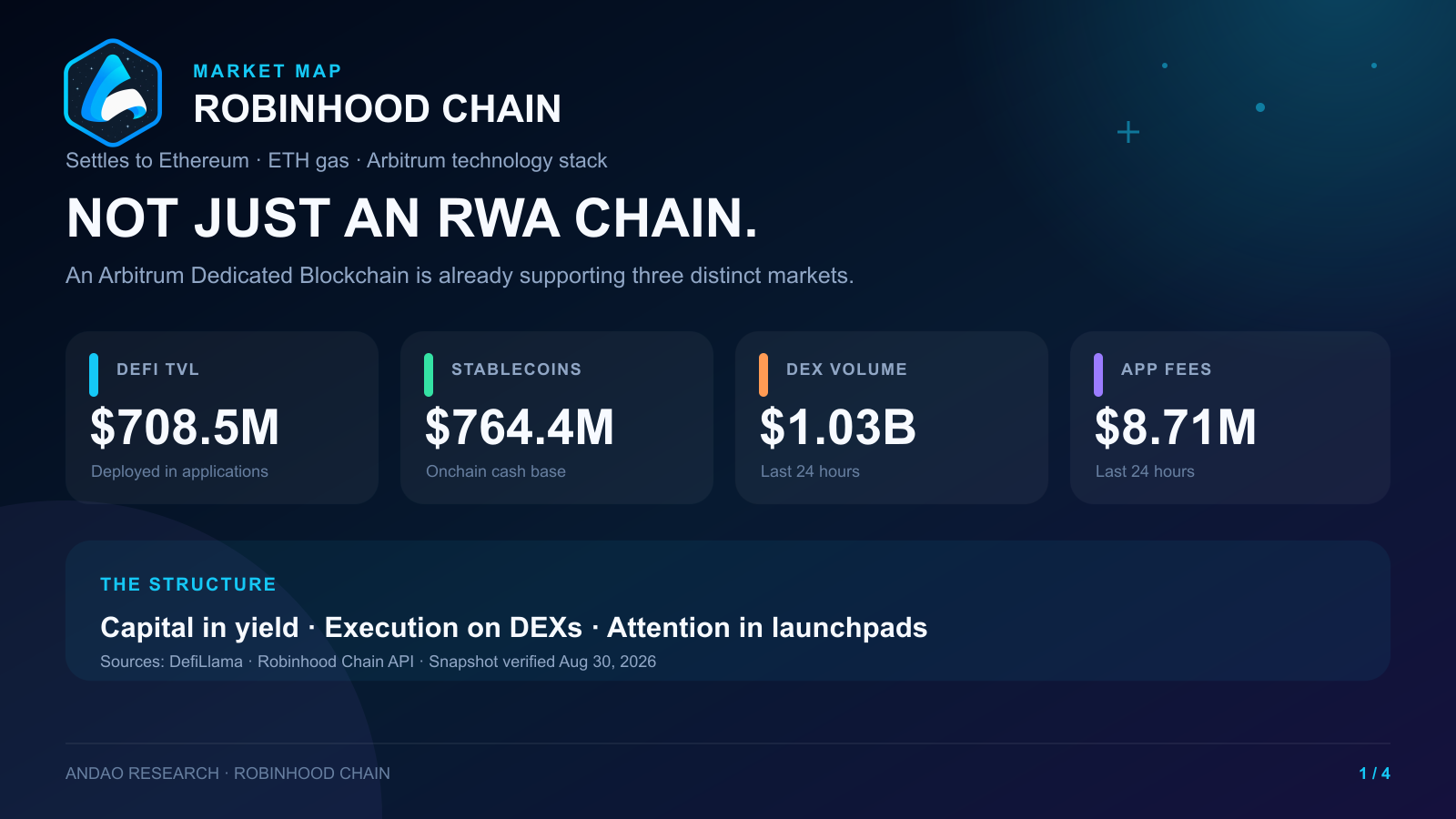
In ANDAO’s August 30 snapshot, public data showed substantial DeFi capital, stablecoin liquidity, decentralized-exchange activity and application fees. These figures should be read as a dated market snapshot rather than a permanent baseline: early-chain metrics can move quickly, and different data providers may classify protocols differently.
The more useful signal is structural. Robinhood Chain already has separate venues competing to hold capital, execute trades and capture attention. That is the beginning of a real onchain economy—not simply a list of stock tokens.
Three markets are emerging at once
The first layer is capital. Stablecoins and lending markets provide the balance-sheet base that users can move between applications. USDG and Morpho were prominent in the August snapshot, while Robinhood’s own earn products created another destination for idle assets.
The second layer is execution. Uniswap accounted for the large majority of tracked decentralized spot volume in the same snapshot. That concentration matters: a chain can host many applications while price discovery and liquidity remain dependent on one dominant venue.
The third layer is attention. Meme markets and newer trading applications can attract users and fees much faster than slower-moving RWA products. This does not invalidate the tokenization thesis. It shows that distribution and speculation often arrive before deeper financial composability.
Why this remains an Arbitrum story
Robinhood’s documentation describes the network as an Ethereum-compatible Layer 2 built with Arbitrum Dedicated Blockchains. It uses ETH for gas and Ethereum blobs for data availability. Developers can use familiar EVM tooling, while the canonical bridge follows the Arbitrum L1-to-L2 architecture.
That positioning is strategically important for Arbitrum. Robinhood first validated tokenized-stock demand on Arbitrum One, then moved toward a dedicated chain with more control over execution and operations. It is a visible example of the “launch on a shared network, migrate when scale requires customization” model promoted by the Arbitrum Platform.
Breadth arrived before depth
Robinhood’s read-only Stock Token APIs expose a broad asset catalog, price information, corporate-action data and token metadata. A large catalog improves discovery, but the number of listed assets should not be confused with evenly distributed liquidity.
The market will become more durable if tokenized stocks are used as collateral, margin assets, portfolio building blocks and liquidity-pool quote assets. Until then, the most active products may continue to be stablecoins, lending and speculative trading rather than the long tail of tokenized equities.
The thesis to watch
The near-term heat is trading. The capital base is stablecoins and lending. The long-term moat is whether Stock Tokens become productive onchain assets rather than isolated representations of brokerage products.
For Arbitrum, the question is equally important: can dedicated chains expand the ecosystem without fragmenting liquidity and user attention beyond repair? Robinhood Chain is now one of the clearest live tests of that model.
Sources and further reading
This article is independent editorial analysis for informational purposes. It is not investment, legal or financial advice.